
Wedding Centerpieces in New Orleans: Designing for the Room and the Guests

Updated: Sep 29
When we design wedding centerpieces, we rarely begin by asking what should go in the middle of the table.
We begin with the room.
The architecture of the venue, the shape and number of tables, the linens, lighting, place settings and overall feeling of the celebration all influence the flowers. A centerpiece that feels completely at home in an intimate courtyard dinner may feel lost in a grand New Orleans ballroom—and something designed for a formal reception may overwhelm a smaller rehearsal dinner.
At Leaf + Petal, we approach New Orleans wedding floral design as part of the entire environment. The goal isn't to choose one centerpiece and repeat it across a room. It's to create a floral story that makes sense for the space and for the people gathering in it.

Start With the Room, Not a Centerpiece Formula
New Orleans gives us an extraordinary variety of spaces to work in. We design weddings in historic ballrooms, courtyards, private clubs, museums, hotels and intimate restaurants, and every room asks for something different.
Before deciding on centerpieces, we look at how the room will actually function. Are the tables round or long? Is the ceiling soaring or intimate? Does the architecture already provide a strong backdrop? Where will guests enter? What will they see from across the room? How much is already happening on the table once linens, china, glassware and candles are added?
Sometimes a room calls for height. Sometimes the most beautiful choice is keeping the flowers low and letting the architecture do the talking. And often, the answer is a combination.
That is why we don't believe there is one formula for the "perfect" wedding centerpiece. The flowers should belong to the celebration around them.

Low, Lush Garden-Style Centerpieces
One of the centerpiece styles we design most often is a low, lush arrangement in a compote or footed vessel.
These arrangements work particularly well with our natural, garden-inspired style because they allow us to create movement rather than a tight mound of flowers. We can layer different varieties, shapes and textures so that the arrangement feels as though it grew into place.

The exact flowers change with the season and the wedding, but the design principles remain similar: interesting varieties, variation in height, beautiful foliage and enough looseness to let individual flowers have their moment.
Low arrangements also allow guests to see one another easily across the table. For a dinner where conversation and the tablescape itself are important, that can be just as significant as how the arrangement looks in a photograph.
Garden Urns for Height and Impact
In larger reception spaces, we often introduce garden urns or elevated floral arrangements to create height.
These aren't simply larger versions of a low centerpiece. Their job within the room is different.
A tall garden arrangement can draw the eye upward, help flowers hold their own against large-scale architecture and create visual interest when guests first enter the reception. Used alongside lower arrangements, it also prevents a room filled with identical tables from feeling repetitive.
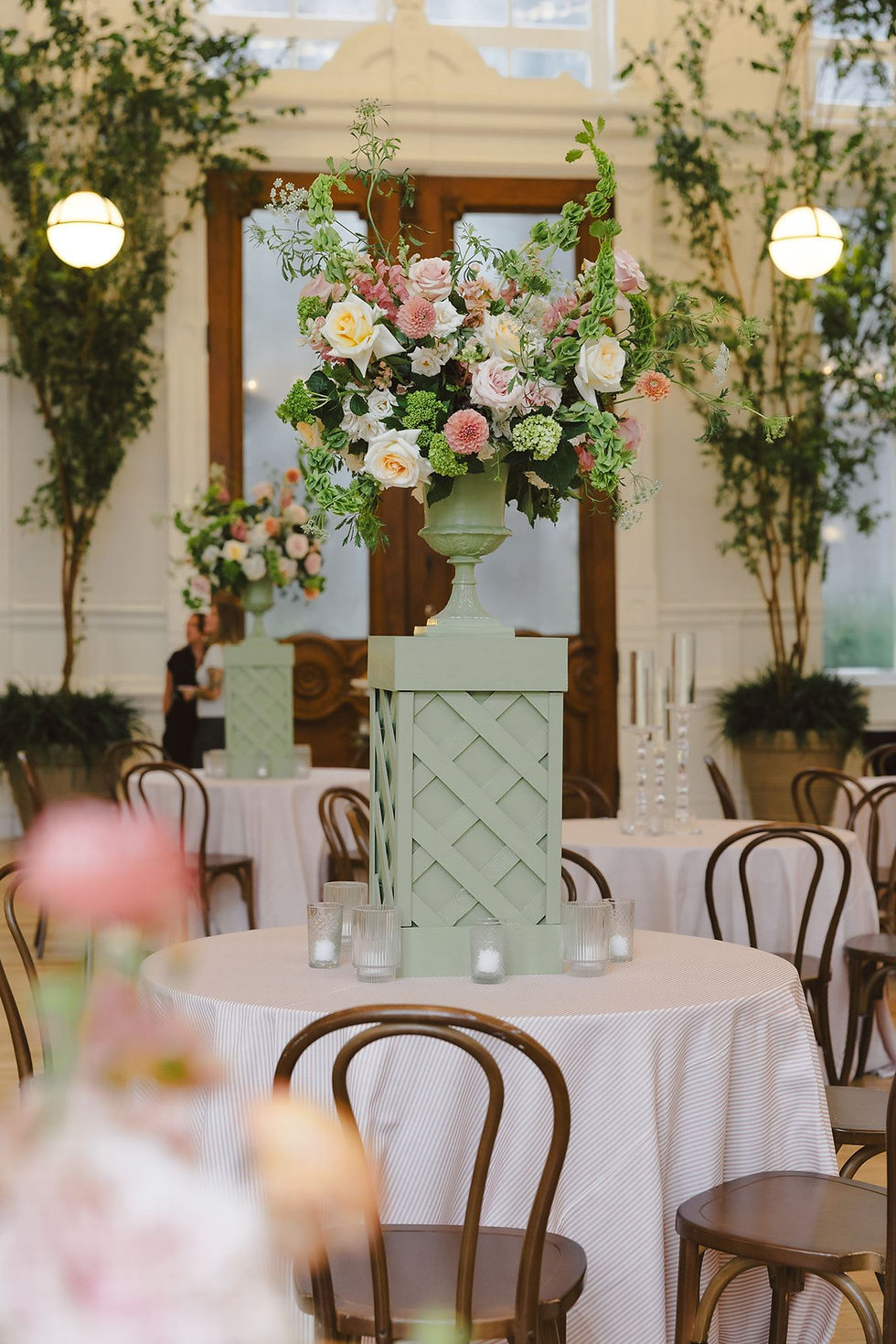
At a spring wedding at New Orleans Country Club, for example, varying the scale of the floral designs allowed the flowers to become part of the room rather than simply decorations placed on individual tables.

The most successful elevated arrangements still feel connected to everything below them—the linens, candles, smaller flowers and the overall palette of the wedding.
Garlands and Flowers for Long Tables
Long tables create an entirely different design opportunity.
Rather than centering the design around one arrangement, flowers and greenery can travel along the length of the table. Depending on the celebration, that may mean a lush garland, clusters of flowers, smaller arrangements woven between candles, or a combination of all three.

We especially love this approach for rehearsal dinners and intimate wedding dinners because it can make the entire table feel like one continuous composition.

The scale matters. A long table already contains a great deal once place settings, glassware, serving pieces and candles are added, so the flowers should work with those elements rather than compete with them.
Bud Vase Tables
Bud vases may be small individually, but a table filled with them can have enormous personality.
We often use collections of bud vases to create a lighter, more layered floral moment. Different flowers can be appreciated individually, and the repetition of vessels across the table creates its own rhythm.

At The Ritz-Carlton New Orleans, small floral moments, linens and candlelight worked together to create the feeling of a garden-inspired dinner rather than relying on a single large arrangement to carry the table.

Bud vases can also be particularly beautiful when the linens, china or other tabletop details deserve attention. Instead of covering those elements, the flowers become another layer within the tablescape.
Mixing Centerpiece Styles Throughout the Reception
Some of our favorite reception designs don't use one centerpiece style at all.
A room might include tall garden urns on some tables, low compotes on others and collections of bud vases elsewhere. Long tables may receive an entirely different floral treatment.

This variation gives a reception dimension. When you look across the room, the flowers rise and fall rather than creating a single repeated line.
It also allows us to respond to the actual layout of the venue. A table positioned against an architectural feature may need something different from a table in the center of a ballroom. The flowers can emphasize important areas of the room while allowing quieter areas to remain quieter.
Our Board of Trade spring floral design is a good example of how varying floral scales can create a cohesive environment without making every surface identical.
Wedding Flowers Beyond the Guest Tables
Reception floral design doesn't stop at the centerpieces.
Once the guest tables are established, we look at the other places where flowers can change how the room feels: the entrance, bars, cocktail tables, mantels, escort displays, stages and, of course, the wedding cake.
Cake surrounds are one of our favorite ways to connect the cake to the rest of the floral design.

Rather than placing a small arrangement on the cake and leaving it isolated in the room, flowers can grow around the base or across the surrounding table, making the cake feel like a true part of the reception design.
These secondary floral moments are also useful for creating continuity. A guest may not consciously notice that the flowers near the cake relate to the centerpieces across the room, but together those details make the entire reception feel considered.
Rehearsal Dinner Centerpieces
Rehearsal dinners give us another opportunity to design flowers around the experience rather than around a traditional wedding formula.
They are often smaller and more intimate than the wedding reception, which can make the table itself a major part of the evening.

Long tables with garlands, bud vases mixed with candlelight, low garden arrangements or a collection of smaller floral moments can all work beautifully. The right approach depends on the restaurant or venue, the meal and how formal—or wonderfully informal—the couple wants the evening to feel.
The rehearsal dinner also doesn't have to look like a miniature version of the wedding. It can have its own palette and personality while still feeling connected to the weekend as a whole.
Designing a Reception as a Whole
The centerpiece is important, but it is only one part of what guests experience when they walk into a reception.

We think about where the eye lands first. We think about what guests see when they sit down for dinner and what the room looks like from across the dance floor. We consider the flowers alongside linens, candlelight, architecture and all the other details that have already been chosen.
Sometimes that leads us to a room filled with lush garden flowers. Sometimes the most beautiful design is restrained. Most often, it is a carefully considered mixture of large floral moments and smaller ones.
That's what makes designing wedding flowers in New Orleans so interesting: no two venues—or celebrations—ask for exactly the same thing.
If you're beginning to plan your reception, you can explore more of our New Orleans wedding floral design services, browse our guide to New Orleans wedding venues, or get in touch with Leaf + Petal to start talking about your wedding flowers.


Comments