
English Garden Wedding Flowers: Ideas and How to Use Them

Updated: Sep 28

There is something about English garden wedding flowers that feels effortlessly romantic. They’re abundant without feeling overdone, loose without looking messy, and filled with the kind of movement and texture that makes an arrangement feel as though it could have grown exactly where it was placed.
At Leaf + Petal, this is naturally where much of our work tends to live. Our approach to wedding flowers has always been garden-inspired: layered, organic, a little unexpected, and designed to feel connected to the space around them.
But “English garden” doesn’t mean using one particular flower or following a specific recipe. It’s much more about how the flowers are chosen and arranged—with movement, variation in height, seasonal blooms, delicate textures, and enough looseness to let individual stems have their moment.
Here’s how we think about English garden wedding flowers and how that style can translate throughout a wedding, from the bridal bouquet to the ceremony and reception.

What Makes Wedding Flowers Feel Like an English Garden?
The best garden-style wedding flowers don't feel overly arranged.
Instead of creating a perfectly round bouquet or a centerpiece where every flower sits at the same height, we build in layers. Some flowers sit low and full, others reach above the arrangement, and smaller blooms and greenery create movement around the edges.
The flowers themselves matter, of course, but the overall composition matters just as much.
Garden roses, peonies, ranunculus, sweet peas, delphinium, foxglove, hydrangea, tulips, dahlias and other seasonal blooms can all lend themselves beautifully to an English garden look. We also love using smaller flowers, flowering branches, vines and textural elements that keep an arrangement from feeling too perfect.
Not every flower needs to be the star. Often, it’s the combination of a beautiful focal bloom with something wispy, trailing or slightly unexpected that gives an arrangement its garden quality.

Choosing Flowers for a Garden-Style Wedding
When we're designing garden-style wedding flowers, we don't begin with a checklist of flowers. We begin with the wedding itself.
The season, venue, color palette, architecture and overall feeling of the day all influence what we choose.
Seasonality is particularly important. A spring garden arrangement might include tulips, sweet peas, ranunculus or peonies, while a late-summer or fall design may lean into dahlias and other flowers naturally at their best during that time.
That doesn't mean every flower has to be locally grown or strictly seasonal. It means we're looking for ingredients that create the right movement and feeling while also making sense for the time of year.
And in New Orleans, we also have to think about heat. A flower that works beautifully for an indoor reception may not be the flower we choose to feature heavily on an outdoor ceremony structure in August. Part of creating a natural-looking design is knowing where delicate flowers can shine and where something sturdier needs to do the work. We've shared more about this in our guide to keeping wedding flowers fresh in New Orleans.
The goal isn't simply to choose beautiful flowers. It's to choose flowers that will be beautiful in that particular place, on that particular day.

English Garden Wedding Bouquets
A bridal bouquet is one of the easiest places to really see the English garden style.
Rather than a tight, symmetrical shape, we prefer bouquets with movement. A stem might arch slightly outside the silhouette. A vine may trail. A few smaller blooms may sit higher than the rest.
The bouquet should still feel intentional, but it doesn't need to look controlled.
We often layer larger focal flowers with smaller blooms and textural elements so the eye moves through the bouquet instead of seeing one solid mass of flowers.
Color can work the same way. An English garden bouquet doesn't have to mean pastel. Soft pinks, creams and pale blues are beautiful, but the same approach works with richer colors as well. It's the layering, movement and variation that create the garden feeling—not one prescribed palette.
You can see that approach in this spring garden wedding at The Ritz-Carlton New Orleans, where the flowers were designed to feel romantic, seasonal and naturally connected to the setting.
Most importantly, the bouquet should feel connected to everything that comes after it. It can introduce the floral language of the wedding without needing to contain every flower or color we'll use throughout the day.

Garden-Inspired Ceremony Flowers
Ceremony flowers are where this style can really become part of the landscape.
For an outdoor wedding, we often start by asking what is already there.
Is there a beautiful tree? An existing garden? An architectural doorway, gazebo or courtyard that doesn't need to be hidden?
Rather than covering a venue with flowers simply because we can, we prefer to build on what's already beautiful.

A garden-inspired ceremony might mean flowers growing asymmetrically around a gazebo, meadow-style arrangements lining an aisle, urns that feel as though they've been gathered from the surrounding garden, or an arch with enough movement that it doesn't look like a perfectly constructed wall of flowers.
The goal is integration. The flowers should make the setting feel more beautiful without making you wonder where the venue ends and the floral installation begins.
This is especially important at New Orleans venues with strong architecture and existing gardens. Our guide to New Orleans wedding venues includes some of our favorite spaces and shows just how different the floral approach can be depending on the setting.
The best floral design doesn't compete with those details. It responds to them.

English Garden Centerpieces and Tablescapes
Garden-style centerpieces don't have to be enormous to make an impact.
Some of our favorite tables use a mixture of low arrangements, compotes, bud vases, fruit, candlelight and smaller floral moments rather than one oversized centerpiece repeated across every table.
Variation can actually make the room feel more natural.
For a long table, flowers can move down the center almost like a garden bed, with blooms appearing at different heights and intervals. For round tables, a footed compote can create that same sense of abundance while still allowing guests to see one another.
We've used this approach in very different settings, including a garden-inspired wedding at Il Mercato and a garden-party-inspired event at the New Orleans Board of Trade. The venues and palettes were different, but the idea was the same: create movement across the tables rather than making every arrangement feel identical.

This is also where the smaller ingredients become especially important. A beautiful rose may catch your eye first, but the tiny flower leaning toward a candle or the vine moving across the edge of a vessel is often what keeps the arrangement from feeling formal or stiff.
The vessel matters too. Aged stone, silver, ceramic, glass and other pieces with character can all reinforce the feeling that the flowers belong in the room rather than simply being placed on top of a table.
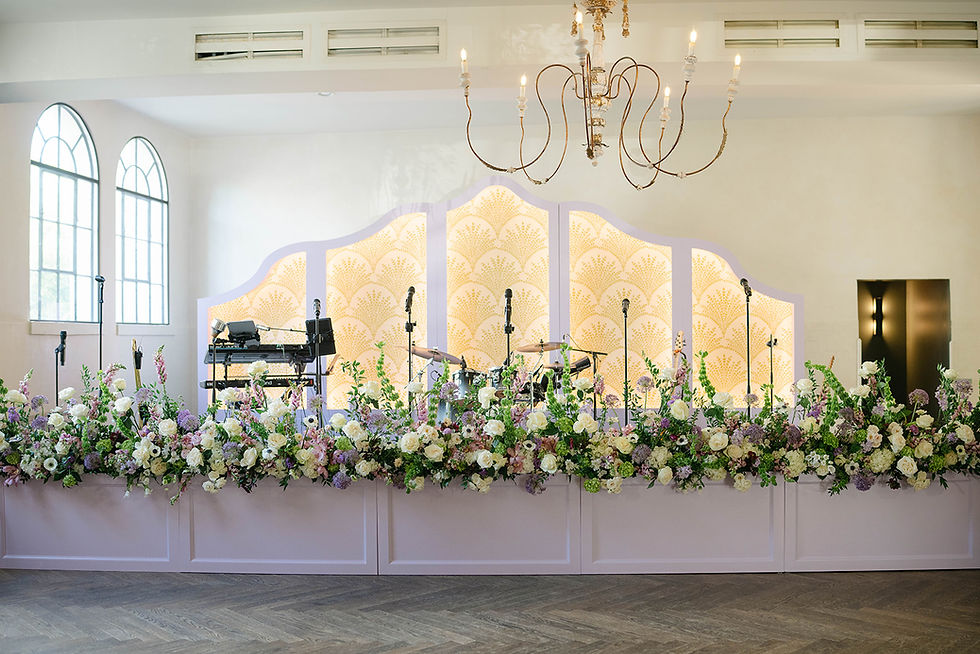
Bringing a Garden Into an Indoor Space
Some of the most interesting garden-style weddings happen in spaces that aren't gardens at all.
A ballroom, warehouse or historic interior can become incredibly romantic when flowers are used to soften its architecture and create movement through the room.
This might mean meadow-style arrangements around a stage, flowers climbing a staircase, an installation surrounding a bar, or greenery and blooms appearing in places where guests don't necessarily expect them.
The idea isn't to disguise the venue. It's to create the feeling that the garden has made its way inside.
We took a similar approach with spring floral installations at the New Orleans Museum of Art, using flowers to create an immersive sense of spring within an architectural space.
This is where scale becomes important. A few loose centerpieces alone won't necessarily transform a large room. Sometimes the strongest design is a combination of intimate details on the tables and one or two larger floral moments that change the way the entire space feels.

Garden Style Doesn't Mean More of Everything
One of the misconceptions about English garden wedding flowers is that the look requires an enormous number of flowers everywhere.
It doesn't.
Abundance and excess aren't the same thing.
Sometimes one beautifully designed arrangement with unusual movement has more impact than three times as many flowers packed tightly together. And sometimes allowing part of a venue, table or ceremony structure to breathe makes the flowers around it feel even more special.
We also don't believe every wedding needs the same collection of trendy garden flowers.
If a particular bloom isn't at its best, doesn't work with the venue or isn't going to tolerate the conditions of the day, we would rather choose something beautiful that does.
The most successful garden-style weddings aren't recreations of a Pinterest image. They feel specific to the couple, the season and the place.

Creating Garden-Style Wedding Flowers in New Orleans
New Orleans gives us an incredible backdrop for this kind of floral design.
Historic homes, courtyards, old brick, ironwork, lush gardens and grand interiors all lend themselves to flowers that feel organic and slightly untamed. But every venue asks for something different.
That's why we don't begin with a predetermined floral package or recipe.
We look at where the ceremony is happening, how guests will move through the space, what already exists at the venue, where flowers will have the most impact and how the entire wedding should feel when everything comes together.
English garden wedding flowers are ultimately less about recreating an English garden and more about capturing what makes a garden beautiful in the first place: movement, seasonality, texture, imperfection and the feeling that something is alive.
That's the part we're always chasing.
If you're planning a New Orleans wedding and love flowers that feel organic, layered and garden-inspired, explore our wedding floral design portfolio or get in touch with Leaf + Petal to start planning your flowers.
When looking into structured reading programs for kids, the process appears quite methodical. It starts with an initial assessment to identify specific skill gaps instead of using a generic program. After that, they match a tutor based on your family schedule and create a personalized plan. You can review https://brighterly.com/online-reading-tutor/ to check how they organize these steps. The lessons are conducted individually with feedback in real time, along with homework support and extra practice sheets. The weekly progress reports for parents are useful because you stay informed without needing to supervise constantly. It seems like a sensible system, though success depends on how well the child responds to the pace.