
Traditional New Orleans Wedding Flowers and Floral Traditions

Updated: Sep 29

There is no single way to have a New Orleans wedding.
Some couples lean into the city's traditions from beginning to end. Others choose a historic venue, add a second line after the ceremony, and let the rest of the wedding feel completely their own. That's one of our favorite things about designing flowers here: New Orleans already brings so much character to a wedding that the flowers don't need to turn into a theme.
At Leaf + Petal, we approach traditional New Orleans wedding flowers the same way we approach any wedding—with the venue, season, architecture and couple at the center of the design.
The result can feel unmistakably New Orleans without feeling like a collection of New Orleans clichés.

What Makes Wedding Flowers Feel Distinctly New Orleans?
For us, it often begins with the setting.
New Orleans wedding venues have incredible built-in character: courtyards, balconies, old brick, ironwork, grand staircases, historic interiors and lush outdoor spaces. Rather than ignoring those details and designing the same flowers we could put anywhere, we like the floral design to respond to them.
In a courtyard, that might mean loose, garden-style flowers that feel connected to the greenery already surrounding the space. Inside a historic building, it might mean large urn arrangements that have enough scale to hold their own against the architecture.
The flowers don't necessarily need to announce New Orleans. The entire room already does that.
Our job is to make them belong there.

Garden-Inspired Flowers and Southern Influence
There is an ease to garden-style floral design that works particularly beautifully in New Orleans.
Instead of arrangements that are tight, round and perfectly symmetrical, we tend to work with movement. Flowers sit at different heights. Branches or delicate stems may extend beyond the main shape. Greenery is used intentionally rather than simply filling space.
The result feels abundant but not overly arranged.
Garden roses, hydrangea, ranunculus, tulips, delphinium, sweet peas, dahlias and other seasonal flowers can all work beautifully within this style, but we don't start with a required flower list.
We start with what is beautiful at that moment and what makes sense for the wedding.
Season matters. So does the venue. And in New Orleans, temperature matters too.
A delicate flower that we love for an indoor spring reception may not be something we rely on heavily for an outdoor ceremony in the middle of summer. Good floral design isn't just choosing beautiful ingredients—it's knowing where and how to use them.

Ceremony Flowers in Historic New Orleans Venues
One of the easiest mistakes to make with ceremony flowers is assuming that more flowers automatically create a more beautiful ceremony.
At many New Orleans venues, the opposite can be true.
When the ceremony already has a beautiful architectural backdrop, courtyard or garden, we prefer to work with it rather than cover it.
That might mean asymmetrical flowers growing around an existing structure, floral meadows lining portions of the aisle, large urns framing the ceremony, or arrangements placed specifically to draw attention toward an architectural detail that is already there.
This is especially true in historic spaces. The floral design should feel considered in relation to the building rather than temporarily dropped in front of it.
For couples still deciding where to marry, our guide to New Orleans wedding venues is a good place to see how dramatically the setting can change the way we approach the flowers.

Flowers and the New Orleans Second Line
The second line is one of those New Orleans wedding traditions that can be joyful, personal and completely integrated into the rest of the celebration.
From a floral perspective, the most important thing is usually practicality.
By this point in the wedding day, bouquets have already been through portraits and the ceremony, and now they're heading outside with everyone else. We think about how personal flowers will hold up, whether the bride wants to carry her bouquet during the second line, and how those details fit into the transition from ceremony to reception.
Some couples also incorporate flowers or greenery into second-line details, but they don't have to. Parasols, handkerchiefs and the movement of the group already create plenty of visual energy.
We'd rather the flowers complement that moment than compete with it.

Wedding Cakes, Entrances and Reception Flowers
Not every important floral moment needs to happen on a table.
One of the things we love about designing a wedding as a whole is finding the places where flowers can change how guests experience the room.
That might be a floral moment at the entrance, flowers surrounding a bar, an installation above the dance floor, a statement arrangement in an otherwise empty architectural space, or a few carefully placed blooms on the wedding cake.
Cake flowers in particular can connect the cake to the rest of the floral design without turning it into another centerpiece. Sometimes a small cluster is enough. Sometimes the cake calls for something more abundant.
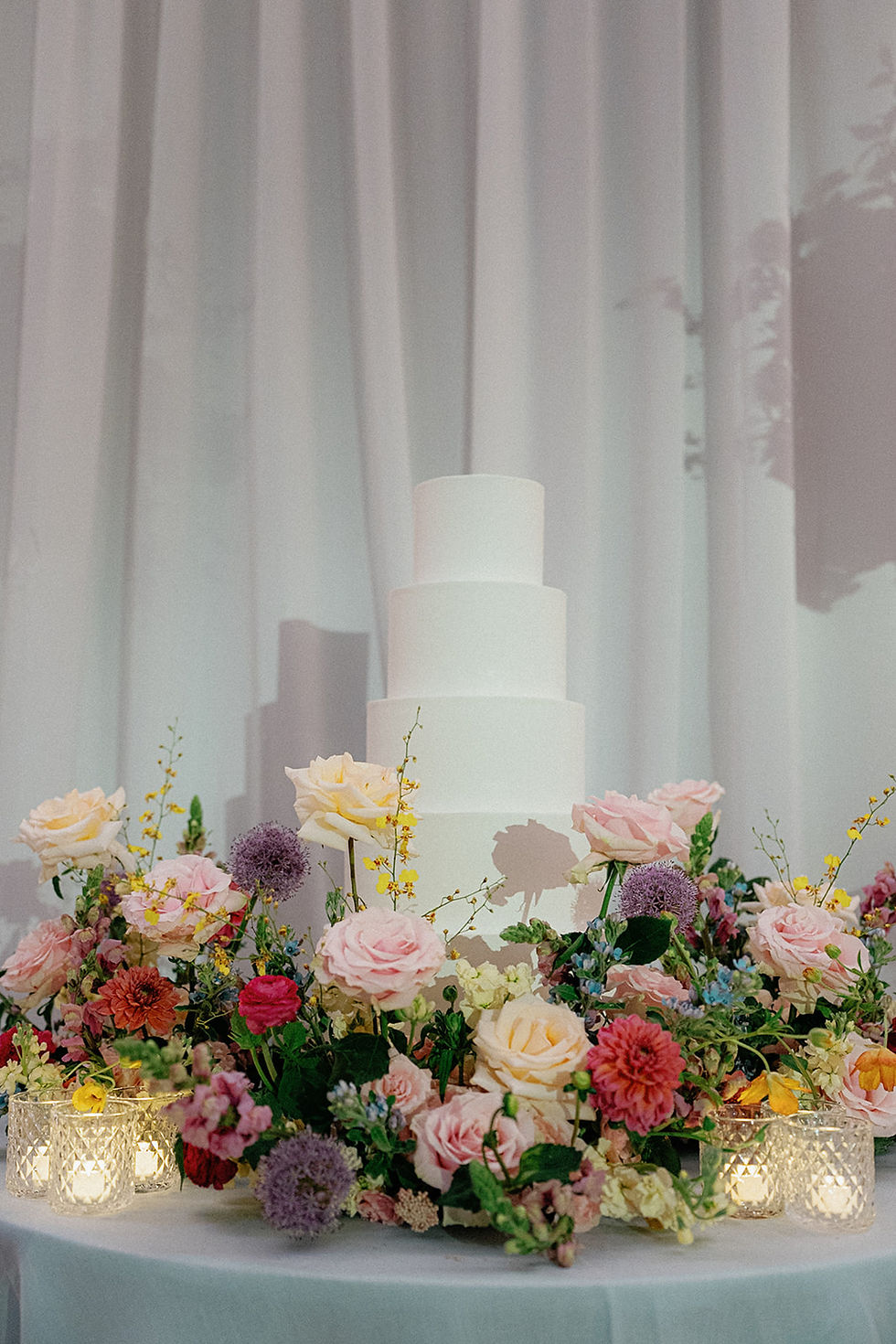
We've shared more ideas for using flowers and greenery on wedding cakes in our wedding cake floral guide.
The same principle applies throughout the reception: flowers should have a reason for being where they are.
Traditional Doesn't Have to Mean Formal
A traditional New Orleans wedding can still feel incredibly personal.
Traditional doesn't have to mean matching arrangements, white flowers everywhere or a ballroom filled with identical centerpieces.
It can mean getting married in a historic space and filling it with loose, colorful garden flowers. It can mean a classic church ceremony followed by a reception that feels completely modern. It can mean incorporating a second line while choosing flowers that have nothing traditionally “New Orleans” about them at all.
Some of our favorite weddings combine those contrasts.

At the New Orleans Museum of Art, for example, bright spring flowers can bring softness and movement into a grand architectural setting.

At the New Orleans Board of Trade, floral design can work at a completely different scale, using the architecture and layout of the space to determine where larger floral moments will have the most impact.
That's much more interesting to us than trying to make every detail fit into one predetermined version of a New Orleans wedding.

Designing for the Venue, Season and Couple
The venue is one of the biggest influences on how we design wedding flowers.
Before deciding what belongs on a table or how large a ceremony arrangement should be, we want to understand the space.
Where will guests enter? What will they see first? Where is the ceremony happening? What architectural details should stay visible? Where will everyone gather during cocktail hour? Does the reception room need softness, height, color or scale?
Then we consider season and logistics.
New Orleans weather can be demanding on flowers, particularly for outdoor ceremonies and portraits. Choosing the right flowers for the conditions—and timing delivery and installation appropriately—is part of the design process, not an afterthought.
And finally, the flowers have to feel like the couple.
Tradition can give us a starting point, but it shouldn't dictate the entire wedding.

A New Orleans Wedding Should Feel Like Yours
There are countless ways to create a wedding that feels rooted in New Orleans.
Sometimes that comes from the venue. Sometimes it's the second line. Sometimes it's the architecture outside the windows, the food, the music or simply having everyone you love together in this particular city.
The flowers are another layer.
They can soften a historic room, transform a ceremony space, bring a garden indoors or add color and movement to a reception. But the goal isn't to make the flowers look “New Orleans.”
It's to make them look as though they were designed specifically for your wedding in New Orleans.
If you're planning a wedding here, you can learn more about our New Orleans wedding floral design services or get in touch with Leaf + Petal to start talking about your flowers


Comments